RongHua Ching

My cook book recommendation: Asian Tofu

Asian Tofu: Discover the Best, Make Your Own, and Cook It at Home

Andrea Nguyen has written a comprehensive guide on how to make tofu based on extensive research throughout south-east Asian region, she has an informative and entertaining writing style, with valuable tips, insights and facts. Most importantly the step-by-step image and written instructions on tofu tutorial, clearly outlines techniques and guides through making many other varieties with easy cooking recipes to prepare dishes.

She describes how tofu has become a star ingredient in the West from alternative to mainstream and how popular it has become today. Tofu is a versatile ingredient a known staple food in the Far East, it has taken the West by storm recognized for its nutritional value and adaptable uses in any cooking style.

I have been making fresh homemade soy milk for many years now and one thing led to another, now with Andrea’s advice I hope to add making homemade silken tofu in my next attempts. I truly can recommend Andrea Nguyen, Asian Tofu book to discover, make, cook and eat to your heart’s delight.


Avocado Chia seeds healthy breakfast

Avocado

Due to its shape and leathery skin, did you know that another name for Avocado is Alligator’s pear? What’s in a name right? 🙂

A biologist calls it persea americana, but avocado derives from the Nahuatl word ahuacatl, which also refers to a certain part of the male anatomy that the fruit somewhat resembles. In English, the word has almost the same pronunciation as the Spanish abogado, “lawyer.” In Mexico it is called the aguacate. Use your imagination to understand why the Aztecs called it the fertility fruit. Legend has it that an early English description of “avocado” called it the “avogado pear,” leading to the misunderstanding of “alligator pear.”  The fact that the shell of the fruit looks vaguely crocodilian doesn’t hurt. (source: dictonary.com)

Avocado, healthy low in cholesterol and sodium

Avocado, healthy low in cholesterol and sodium

A fruit native to Mexico and Central America, much eaten as a vegetable and the main ingredient to make famous guacamole dip with tortilla chips. With great benefits to this mighty fruit, a serving size of 150 gram has 240 calories, very low in cholesterol and sodium. Rich source of Dietary Fibre, Vitamin C, Vitamin K and Folate. Supports cardiovascular health, promotes blood sugar regulation and has anti-cancer benefits. It is no wonder why Avocado is considered among the World’s healthiest foods.

Chia Seeds

Another health food native to the same region is Chia Seeds (the seeds come from a flowering plaint in the mint family) an important crop and super food for the Aztec’s it was largely unknown in North America until researcher Wayne Coates began studying Chia 29-years ago. Chia is the highest currently known plant source of omega-3 ALA, which is able to convert into both EPA and DHA. Rich in anti-inflammatory activity, has a huge nutritional profile. It contains calcium, manganese, and phosphorus as an added benefit, chia seeds can be eaten whole or milled. Or making a gel by adding liquid for instant pudding or as an egg or butter substitute. 

Avocado Chia seeds mash healthy breakfast

Avocados are regular ingredients in our fruit basket, last week there was a health products promotion at the discount chain store Action for Chia seeds and I bought two packages to add them to our diet. Half way through a hectic week, I needed a healthy boost so I came up with this preparation an Avocado and Chia seeds mash. A healthy breakfast alternative recipe, spiced up with a bit of SiChuan pepper powder and a sprinkle of red pepper flakes on toasted Corn bread. Perhaps you could use a #transformationthursday superbooster too with all these ingredients loading up energy, watch out Friday!

Avocado Chia Seeds Healthy breakfast

Avocado Chia Seeds Healthy breakfast


Youth tea art contest in Hangzhou, China

Three days ago a Chinese youth Tea Art competition kicked off in HangZhou, capital of Zhejiang Province and Tea centre. During this contest 19 pupils showed their knowledge of tea and skills of tea art. To view more photographs click on this link Youth tea art contest kicks off in Hangzhou[1]- Chinadaily.com.cn.

Tea Art

The habit of drinking tea in China started during Zhou dynasty (1066-256 BC).  The skill of making and serving tea was regarded as important as early as the Han dynasty (206 BC-220 AD). Zhu Xi, a South Song dynasty philosopher, started the practice of drinking tea in a certain ritual and his tea ceremony was handed down and further highlighted by such scholars such as the 8th Century scholar, Lu Yu (Tang dynasty) and Huang Ru Ze (Song dynasty).

Today, the tea ceremony is being revived by overseas Chinese and it is a popular cultural activity. Lu Yu wrote a book named Cha Jing in which the origin, the production, the utensils, the making and the drinking of tea were discussed. He also popularised the art of tea drinking as he travelled widely and associated with all kinds of people ranging from scholars to businessmen. (source:chinatravel.com)

Tea is enjoyed by any age and as mentioned before in my other tea related posts, there is much, much more than just putting a kettle on for a pot of ordinary tea. Real tea embodies flavour and fragrance, the preparation of soaking the exact amount of time followed by pouring tea where its centres on that perfect moment. With more than 2,000 years of history an abundant choice of tea leaves, the story continues and luckily many tea moments to linger on.  

For those who are interested in Tea Art Daniel Lui has written an insightful “Gong Fu Cha – The Complete Guide to Making Chinese Tea”, you can download his guide as pdf file. He manages and owns The Chinese Tea shop and blogs with an online forum, I encourage you to read his Tea reviews.

Motivation Monday put action into reality

Pay it Forward!! That’s my motto to start the week; I Care and I Love to Share.

Igniting #motivationmonday, sharing what moves my juice, what drives my passion and what puts my actions into reality. How about you? I invite and dare you to share your daily quote, motivational thought into action. Paying it forward, sharing action into reality.

By Paying it Forward we all can make a difference with ease without hard labour or over thinking thoughts, simple random acts of kindness can brighten up someone’s day or motivate into action. Keep following steps in mind;

  1. Be attentive opportunities are everywhere, look around and notice what surrounds you.
  2. Random act of kindness doesn’t hurt anyone and goes a long way.
  3. Spread the word; “Sharing is Caring”.
  4. Multiply a good deed, practice the act of kindness by doubling, tripling or quadrupling an action or effort.

What I like and recommend for this #mondaymotivation is Suspended Coffee.  Suspended coffees www.suspendedcoffees.com is a cup of coffee paid for in advance by a willing coffee shop customer as an anonymous act of charity for anyone who is in need and with less fortune.

The idea originated in Naples, Italy around 100 years ago. Customers of coffee shops would pay twice for one espresso, instructing the barista to log the paid but untaken beverage in an “in suspense” chart (caffè pagato or a caffè sospeso). The barista would record what the patron paid for, such as an espresso, cappuccino or even a pastry. Paid items would remain in the log book until someone less fortunate would come and inquire if there was anything paid for or in suspense. The barista would check the log and say: “Yes, there is a paid cappuccino. May I serve it to you?” The beauty of this form of charity was multifaceted.

#MotivationMonday

rp_motivation-monday-1024x1024-e1397462899146.jpg

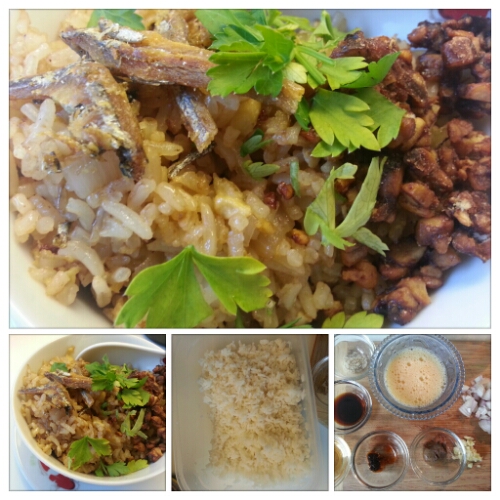
Rice with dried anchovies, quick stir-fry for lunch

With a few ingredients it is simple to make rice with dried anchovies in a tasty lunch, a quick stir-fry and your good to go. I had some leftover rice, dried anchovies and last bit of tempeh kering (Indonesian snack) to add an extra crunch to the dish. Have to make a new batch of Tempeh Kering or other dishes with tempeh, I am trying my hand to make tempeh at home. As soon as that experiment works I will post my findings accompanied with a dish.

Dried anchovies are versatile in Asian cooking, they are either used for broths like in Japanese, Korean soup and stews, appetizers. In Chinese home-cooking often combined with fatty dishes as in steamed Chinese style meatloaves. Or deep-fried called Ikan billis it accompanies Nasi Lemak, coconut infused rice wrapped in banana leaves. One of many favourite Singapore/Malaysian dishes. Sambal belacan ikan billis is another one, sambal belacan is a spicy chilli paste which can be added during cooking or eaten as condiment often served with Laksa. The more talk about food and we’re wandering away from our stir-fried rice.

image

As shown on the photo, these are all the ingredients to start the stir-fry some leftover rice, egg, shallots, garlic, shrimp sauce/paste, chilli-soy paste, soy sauce with  Chinese cooking wine and a heated wok. For the photo I scattered some celery leaves on top, but it is tastier  with coriander and green onions unfortunately all finished it sure was time to shop for groceries too.

Rice with dried anchovies

A quick and easy stir-fry, an assembled dish of various ingredients it has literally a bit of China, Indonesia in it you’ll find the recipe in the box below.

YumNua Yang, ยำเนื้อย่าง Thai beef salad

Thai beef salad recipe with authentic aromatic flavours and an enticing complexity of sweet, sour, spice and heat combined with grilled marinated meat. This dish is one of our family & friends favourites.

Quick and easy to prepare, serve the salad as a starter for lunch or as a side with other complimentary dishes together as Thai dinner theme. The recipe as always retrieved from my memory vault with all the ingredients and steps but no good food photographs.

I couldn’t have a better excuse to make this dish today. Usually, as soon as the dish arrives at the table it disappears to late to make any snapshots. Prepping the dish received much enthusiasm of my better half he replied: “Somebody got to eat happily to help :-)”.

The family loves salad and Thai beef salad ranks on top of all time favourites in our house. We actually moved and lived in Asia for more than a decade. Taiwan became our second home but Thailand was very close sharing the same position, both destinations were foodies paradise.

Thailand

I visited Thailand for the very first time by invitation to come along with friends. My husband couldn’t accompany me so my sister joined as a travel companion. We both thoroughly enjoyed our sister’s holiday and Thai cuisine.

Of the many dishes we devoured, YumNua Yang a.k.a. Yum Neua was among the first plates of much more to come. We re-visited Thailand on many more occasions travelling through all the regions. The roadside street food stalls, night food markets or restaurants beautiful plated and served local style.

The heart of this dish must be a good piece of beef, sirloin or steak cut. Cheaper cuts like a skirt or flank steak after grilling let it rest (10min.) before cutting. Next is the authentic fresh made dressing of fish sauce, garlic, bird’s eye chilli, palm sugar, lime juice, coriander, Thai/Chinese celery. Mint and lemongrass (optional).

marinated pan-fried rib eye steak

marinated pan-fried rib-eye steak

Thai flavours

To create Thai flavours, you have to look at the ingredients and some of them just can’t be ignored or simply substituted, the basis is fish sauce, just buy a small bottle don’t think for a minute to easily replace this with vinegar or soy sauce.

Vinegar only has acidity no umami (savoury taste/flavour), I love soy sauce but it will not do justice to this dish, same counts for palm sugar if you don’t have then rather use brown or cane sugar it adds more depth than white sugar.

Lime or lemon juice it is just a subtle contrast but when you grate the rind it will release essential oils, the scent enables you to tell and smell the difference. Coriander is an essential herb as is celery and lemongrass add fragrance to the whole dish bringing it all together to the next level.

They are actually irreplaceable if left out everyone will notice something is missing even while you have a good steak on your plate. The dressing needs to have the complexity of sweet, sour, spice, heat and fragrance to make YumNua or leave it bland and that would put the dish to shame.

In this recipe, I have marinated the meat beforehand it is worth the wait and effort to add this step, use a bit of fish sauce with black and white pepper and a dash of Chinese cooking wine (optional).

YumNua Yang ยำเนื้อย่าง Thai Beef Salad

You will find the recipe in the recipe box here below, enjoy this wonderful dish. Try and enjoy your own home-made YumNua Yang, Thai beef salad!

YumNua Thai Beef Salad ingredients

YumNua Thai Beef Salad ingredients

Update 20th June 2017

With every summer this recipe is trending on our Instagram and FB Page as a popular recipe easy to make and enjoy. For dieters following Keto, Paleo diet based on LCHF or Type 2 diabetes  this dish is perfect with the following dietary adjustments.

In Thai cooking Palm sugar is often used and advertised with health claims having low glycemic index, however, this does not directly apply for sweeteners. For Bulletproof fans “Coconut palm sugar is not Bulletproof period“, click the link for a post by guru David Asprey.

I recommend Lakanto all natural sweetener, a product of Chinese Luo Han Guo aka monk fruit sugar to replace standard sugar.

Monk Fruit or Luo Han Guo (Siraitia Grosvenorii) is a rare perennial plant cultivated mainly in the mountains of Guangxi Zhuang Autonomous Region in China. Unlike most fruits, whose sweetness comes from fructose, Monks Fruit’s sweetness comes from natural mogrosides that are 300 times sweeter than sugar. Modern research shows that Monk Fruit extract does not elevate blood sugar or insulin. These fruits are powerful antioxidants and contain no calories

In Traditional Chinese Medicine (TCM) the healing properties have been known for centuries. Luo Han Guo is native to southern China and northern Thailand.

You can easily buy this fruit in dried powdered form at larger Asian supermarkets and fresh when the season arrives, they are exported and available for a short period to eat or use the fruit in cooking.


[recipe]

Quinoa Tabbouleh Salad Gluten-free

Many summers back we had an impromptu BBQ dinner with friends at our Taiwanese home. Our guests brought Pot Luck to our home, one of the dishes a fantastic Tabbouleh salad made with bulgur. My first attempts to remake Tabbouleh was disappointing since then I learned of my mistakes such as not squeezing hard enough to remove all liquid.

While parsley is the main herb ingredient, you can easily make adaptations with other herb options. Based on this salad but creating a different taste is by adding 1 tablespoon of sun-dried tomato tapenade instead of tomato puree for a pronounced flavour.

A healthy dish with memories, running out of bulgur gave room for another twist by preparing this salad with Quinoa seed. With every bite, the seeds will pop a little giving it an extra dimension.


With no fresh lemons available nor bottles of lemon juice, I substituted with Chinese rice vinegar and adjust seasonings for the olive oil based dressing. The same reason I tried Apple vinegar which would be my last resort since it has a higher acidity you need less. So start with just one tablespoon and increase with half if needed.

Last summer our youngest came back from her holiday in Morocco with student peers. She brought Aragan oil purchased from a local vendor in a small village. There’s a reason why it is called Moroccan liquid gold as one of the rarest oils in the world.

The nutty taste and fragrance is absolute heaven! I am not an exaggerating type but Aragan oil really does give an extra dimension to salad dishes. If not available you can replace with walnut oil, olive oil will work but has a different end taste.

Liquid gold, it is an unequalled and understandably rare commodity outside of Morocco. A food gem in my kitchen cabinet for as long as the treasured food gift last.

Quinoa Tabbouleh Salad, Power food

Quinoa Tabbouleh Salad


Quinoa Tabbouleh Salad

Quinoa is a basically a powerhouse full of nutritional value and a good choice on the menu. A super grain high in protein and fibre, an ancient seed re-ignited as a super food. If Aragan oil is gold liquid than the mother grain of the Inca’s are gold nuggets. Apparently, NASA sent astronauts into space with Quinoa on the menu as the power food.

Today’s Tabbouleh version has no parsley, instead, it is prepared with fresh mint and coriander. You can serve the dish for lunch with bread, dinner or barbeque as a side dish.

For other salad inspiration, try our Red Beet Salad with Orange, Feta Cheese, Mint recipe or Yum Nua Thai Beef Salad recipe.

[recipe]

Tea connection, introducing The Tea Urchin

Tea Connection

For the love of Tea, I’ve made a wonderful connection with the owners of Tea Urchin, Eugene & Belle. I have been following Tea Urchin’s blog for quite a while and the main reason is their ongoing search and tea explorations but what attracted me the most are the wonderful travel stories, discoveries, people and affinity with their surroundings.

Through Eugene’s writings you can read their passion and engagement sharing tea experience from a wide angled view. Their home is in ShangHai, China, but in our recent email exchange Eugene shared with me that he and Belle visited The Netherlands while on honeymoon. So there you have another introduction, live is a series of moments invisibly string together.

Tea Urchin: mountain tea – hand picked leaves


Why Tea Urchin?

Eugene & Belle launched Tea Urchin to share their love of Chinese tea with the world. Eugene is an Australian who moved to Shanghai in 2004, where he discovered gongfu cha & became obsessed with puer. There he met & married Belle, a feisty Shanghainese tea lover with a penchant for sweet reds & fragrant oolongs.

Together, we travel around China, collecting rare, hand crafted teas. We love finding good tea, made by good people, and we help them to find an international market. We also specialize in premium tea ware from Yixing, Jingdezhen, Longquan & Taiwan.

We go the extra mile to produce our own puer tea, called “Cha Ren” (茶仁 which means “tea compassion”). Each year, we travel to Yunnan to source traditional, hand crafted puer teas directly from the best farmers. We work with the same trusted tea-makers each year, to ensure our tea is pesticide free, and not blended with cheaper or inferior teas. You can meet our producers & follow our tea adventures on our Tea Urchin blog.

Tea connection: Eugene & Belle – The Tea Urchin

I am delighted to share our tea connection with their latest publication about Tea, specifically Chinese Tea the process of tasting and grading Chinese teas. Just click on the title link below.

Cupping Tea- How to taste and grade Chinese teas


Tea Urchin website

Tea Urchin website


Tea webshop www.teaurchin.com 

Cupping Tea – How to taste and grade Chinese teas

Guest post contributed by The Tea Urchin blog. Chinese Tea ceremony, tea grading

Cupping tea is a sensory process of tasting and evaluating the quality of loose leaf tea.

For the past 3 years, Belle has been studying Chinese tea ceremony 茶艺 and tea grading 茶叶审评 at a Government technical college.

In a typical 6 hour class, you have to taste and grade 4 different teas, standing up the entire time. To pass the course, there are 8 types of tea one has to be able to recognise and grade – Shui Xian, Tie Guan Yin, Long jing, Bi Luo Chun, Dian Hong, Qi Men, Shou Puer, and Mo li hua cha (Jasmine tea)

In the beginner’s course, they give you 2 different samples of each tea type, and you have to judge which one is higher quality and why. In the intermediate course, you have to correctly grade 3 different samples of each tea.

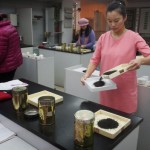
The classroom is made up of several tasting stations, each station consists of a black table and a white table, the black table is for grading the dry tea leaves, and the white table is for tea tasting & grading the wet tea leaves.

On the black table are 3 tins, all of the same tea type.

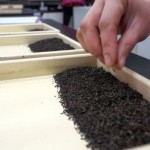
Starting with the first tin, pour all the tea onto a wooden tray, who’s Chinese name is Yáo pán (摇盘) or “shaking tray”. This specialised yáo pán has a light background designed to contrast with the dark tea leaves.

Pour the tea from one tray to another. Do this 3 times, to evenly mix the tea leaves. Then use two fingers to push about 150-200g of tea, onto one tray, whilst the remaining tea is poured back into the tin. Repeat this process with the 2nd tin, before proceeding to the 3rd.

Carefully weigh 3g of tea for each tasting cup, 5g if it’s a Wulong tea. For long, Gaiwan’s are used instead of tasting cups, and the tea is infused 3 times instead of once (2 minutes for the first infusion, 3 minutes for the second infusion, and 5 minutes for the third infusion).

The tea is placed into tasting cups, and water is added. As the minerals in the water can greatly influence the flavour, it’s important to use the same filtered water, ideally freshly boiled. In the tea cupping & grading class, boiling water is used for all tea’s, they do not lower the water temperature for green teas (although they do in the tea ceremony class).

With the exception of Wulong, most tea’s are left to infuse for 5 minutes. Meanwhile , he leftover dry tea leaves in the tray are gently centrifuged by hand, separating the dry leaves into layers. The larger, heavier leaves naturally gravitate towards the center of the yaopan, with the smaller, broken fragments at the edges. This makes it easier to compare the 3 samples, although to the untrained eye, they still look almost identical.

Taking the best tea leaves from the center of the heap and spreading them out on the empty part of the tray allows one to examine the best leaves whilst also exposing the middle layer. Comparing the top, middle and bottom of each pile, gives you a better idea of the overall quality of each sample.

An electronic timer tells you when to pour the tea out. The tasting cups are placed on their side, so the edges of the bowl pin the lid to the cup body. If done right, the tea liquor drains into the tasting bowl, from a single hole in the cup. Getting the balance right takes a bit of practice, as the edge of the bowl only has a small overlap with the cup lid. If the lid is not tightly pressed to the cup, it will slip open, and tea & tea leaves will rush out the sides.The last few drops of tea have a lot of concentrated flavor, and every drop must be extracted from the cup for a fair tasting. A few quick flicks of the arm are sometimes necessary. Use a sieve to remove any stray leaf fragments or dust that might otherwise affect the tea flavor. The contents of the sieve are dumped onto the small black tray in front of each bowl, then the sieve is rinsed before moving onto the next bowl.

Lifting the lid up slightly, analyze the aroma one nostril at a time. This reveals more aroma than using both nostrils at once, as each nostril activates different olfactory receptors. There is a standard desired aroma for each tea, for example, in the case of Bi Luo Chun green tea, you’re looking a very fresh, tender (嫩) & floral aroma. Unusual, weak or stale aroma indicate lower quality. Quality in these comparative tastings is relative. Sometimes all the samples are low quality, so the tea grader has to make an overall assessment based on multiple criteria to draw out the strengths & weaknesses of each tea. Other times there’s a tea which clearly stands out on apperance, and its superiority is quickly confirmed via aroma & tasting.

There’s no time to stop to take notes. It’s important to assess the color of each tea and taste it before it cools. Especially with red tea and puer tea, the tea liquor can get cloudy as it cools. This can sometimes be a sign of high quality, as flavourful leaves release more caffeine, theaflavin, and polyphenols into the water.

Using a porcelain tea spoon, take a short, noisy slurp of each tea. The purpose of slurping is to aerate the tea and spread it out over the entire palate at once. There is a spittoon under the table, but when only tasting a few teas, it’s better to swallow, and appreciate the feeling in the throat and the after taste. Be careful to rinse the spoon between slurps, to avoid contaminating your samples.

Next, remove all the wet leaves from the tasting cup or gaiwan, and spread them out evenly on separate trays. Look for consistency in the leaf shape, texture and color. Leaves should be robust enough to rub between the fingers without desiccating. The brightness of the leaf color indicates quality.

Now its back to examining the dried leaves. Tip the yáo pán to heap them down at one end.

Take a pinch off the top and scatter it out. The light color of the yaopan makes it easier to examine the consistency of leaf shape and tightness of rolling. Usually it’s easier to determine the worst tea first, the top 2 grades can be harder to distinguish. When grading Qimen hongcha, we are looking for darker colour, more shiny instead of dull, and consistently narrow, tightly rolled leaves that look delicate but are unbroken – these are all indicators of higher quality tea leaves & greater care in processing. Lower quality leaves lack consistency, are loosely rolled, and often lack the sharp narrow bud tips, which have broken off during processing or handling.

The last step is to write down your findings. The form shown below uses nomenclature such as APPEARANCE: leaf shape, consistency, cleanliness, color & brightness. SUBSTANCE: aroma, tea color, mouthfeel, wet leaves quality & hand feel. Filling out the form requires a thorough meditation on the outer and inner qualities of the leaf, and a good memory!


By this stage in the process, it is quite common to have spent over 30 minutes examining this tea, and the whole grading process must be completed within 40 minutes, before moving onto the next station. It is not as straight forward or as easy at it sounds, but it’s certainly fascinating, and fun! All of this equipment can be purchased online, and with this guide you can now try it for yourself at home!

All photo credits: The Tea Urchin  | Eugene & Belle

Who are The Tea Urchin? Read the introduction just click on the link Tea connections, introducing The Tea Urchin

I highly recommend to visit their fabulous Tea Urchin webshop for premium teas and superior tea pots and tea wares.

Shingen-ko Samurai Festival travel to Japan

Every year, the Shingen-ko Festival celebrates the legacy of Yamanashi’s famous warlord, Takeda Shingen, with the roars of samurai and folks people, delicious food and materials at stands around the station and the castle park with cherry blossoms in full bloom, and a variety of stage shows and performances!

Unrivalled view of the past, before Shingen’s army, headed off to battle more than 1,600 infantrymen from all over his domain would gather and march through the streets of Kofu. If you have travel plans or searching for information for your itinerary, bookmark this event to visit during Spring time in combination with many other Cherry Blossom events.

Shingen-ko Samurai Festival Photo credit: Yamanashi-kankou

Shingen-ko Samurai Festival
Source courtesy and Photo credit: Yamanashi-kankou

This year’s festival will be held from April 4th to 6th. The main highlight is the Koshu Battalion Deployment, which is World’s largest re-enactment of warriors. Around 1,600 locals dress in traditional samurai and commence on a march around Kofu.

For more information visit the official Tourism website of Mount Fuji in Yamanashi prefecture “Home of Mt. Fuji”; sightseeing website, information on festivals, culture & Resorts Hot Spring resorts.

Map photo credits: www.mustlovejapan.com

Map photo credits: www.mustlovejapan.com


Tripadvisor NL 300x600

This is by far the most popular samurai festival in Japan. The participants spend the entire year practising for their roles in this event that imitate the battle of Kawanakajima. The armour was worn and the equipment carried is spectacular and accurate. This event would probably be the most recommended event to witness, especially for anyone interested in Japanese samurai culture and Takeda Shingen. The festival is held by Takeda Shrine. To help plan your itinerary and ideas for sightseeing, places to visit, things-to-do visit the video travel guide to Japan; Watch Japan in Motion by Must Love Japan.

To get more ideas for suggested itineraries try Japan the official guide as another source to help to find your destinations or just for more insights all mentioned websites are in English. Visiting Japanese Onsen is a relaxing must and absolute worth to consider and plan as a destination,  Japan the official guide has a listed overview of all Hot Springs here.