
China

Youth tea art contest in Hangzhou, China

Three days ago a Chinese youth Tea Art competition kicked off in HangZhou, capital of Zhejiang Province and Tea centre. During this contest 19 pupils showed their knowledge of tea and skills of tea art. To view more photographs click on this link Youth tea art contest kicks off in Hangzhou[1]- Chinadaily.com.cn.

Tea Art

The habit of drinking tea in China started during Zhou dynasty (1066-256 BC).  The skill of making and serving tea was regarded as important as early as the Han dynasty (206 BC-220 AD). Zhu Xi, a South Song dynasty philosopher, started the practice of drinking tea in a certain ritual and his tea ceremony was handed down and further highlighted by such scholars such as the 8th Century scholar, Lu Yu (Tang dynasty) and Huang Ru Ze (Song dynasty).

Today, the tea ceremony is being revived by overseas Chinese and it is a popular cultural activity. Lu Yu wrote a book named Cha Jing in which the origin, the production, the utensils, the making and the drinking of tea were discussed. He also popularised the art of tea drinking as he travelled widely and associated with all kinds of people ranging from scholars to businessmen. (source:chinatravel.com)

Tea is enjoyed by any age and as mentioned before in my other tea related posts, there is much, much more than just putting a kettle on for a pot of ordinary tea. Real tea embodies flavour and fragrance, the preparation of soaking the exact amount of time followed by pouring tea where its centres on that perfect moment. With more than 2,000 years of history an abundant choice of tea leaves, the story continues and luckily many tea moments to linger on.  

For those who are interested in Tea Art Daniel Lui has written an insightful “Gong Fu Cha – The Complete Guide to Making Chinese Tea”, you can download his guide as pdf file. He manages and owns The Chinese Tea shop and blogs with an online forum, I encourage you to read his Tea reviews.

Tea connection, introducing The Tea Urchin

Tea Connection

For the love of Tea, I’ve made a wonderful connection with the owners of Tea Urchin, Eugene & Belle. I have been following Tea Urchin’s blog for quite a while and the main reason is their ongoing search and tea explorations but what attracted me the most are the wonderful travel stories, discoveries, people and affinity with their surroundings.

Through Eugene’s writings you can read their passion and engagement sharing tea experience from a wide angled view. Their home is in ShangHai, China, but in our recent email exchange Eugene shared with me that he and Belle visited The Netherlands while on honeymoon. So there you have another introduction, live is a series of moments invisibly string together.

Tea Urchin: mountain tea – hand picked leaves


Why Tea Urchin?

Eugene & Belle launched Tea Urchin to share their love of Chinese tea with the world. Eugene is an Australian who moved to Shanghai in 2004, where he discovered gongfu cha & became obsessed with puer. There he met & married Belle, a feisty Shanghainese tea lover with a penchant for sweet reds & fragrant oolongs.

Together, we travel around China, collecting rare, hand crafted teas. We love finding good tea, made by good people, and we help them to find an international market. We also specialize in premium tea ware from Yixing, Jingdezhen, Longquan & Taiwan.

We go the extra mile to produce our own puer tea, called “Cha Ren” (茶仁 which means “tea compassion”). Each year, we travel to Yunnan to source traditional, hand crafted puer teas directly from the best farmers. We work with the same trusted tea-makers each year, to ensure our tea is pesticide free, and not blended with cheaper or inferior teas. You can meet our producers & follow our tea adventures on our Tea Urchin blog.

Tea connection: Eugene & Belle – The Tea Urchin

I am delighted to share our tea connection with their latest publication about Tea, specifically Chinese Tea the process of tasting and grading Chinese teas. Just click on the title link below.

Cupping Tea- How to taste and grade Chinese teas


Tea Urchin website

Tea Urchin website


Tea webshop www.teaurchin.com 

AMT Seminar 26 March: The new middle class in China – who are they?


China Leiden China-gerelateerde lezingen en andere activiteiten aan de Universiteit Leiden

China Leiden
China-gerelateerde lezingen en andere activiteiten aan de Universiteit Leiden

AMT Seminar 26 March: The new middle class in China – who are they?Posted: 24 Mar 2014 08:04 AM PDTTime
15.00-17.00 hrs

Venue
Lipsius Building Room 148
Cleveringaplaats 1
2311 BD Leiden

Everyone is welcome!


The new middle class in China

The new middle class in China – who are they? What are their dreams? What do they worry about? Can you be happy in a dictatorship? And how about sex?

Journalist and anthropologist Sybilla Claus writes for the Dutch daily newspaper Trouwabout East Asia. She will talk about two special projects she researched in China.

  1. Wherever you look, China is building apartment buildings. In 2020 there will be hundreds of cities with a million inhabitants. But who is living in all those flats? Sybilla Claus lived for a week in Tower XII of a new high-rise complex.
  2. Soul searching: the changing moral landscape.
    a. Chinese citizens are better off economically, and feel emotionally liberated. But can the modern Chinese be happy in a dictatorship?
    b. A sexual revolution is happening in China, of course in Red style. How do citizens find their (erotic) way between the do-nots of censorship?
    c. Chinese are world champions in hard working and making money – but spending it is a different story. Philantrophy and volunteer work are upcoming phenomena.


MEARC


Modern East Asia Research Centre (MEARC)’s mission is to be an international centre of excellence for research on contemporary East Asia. MEARC aims to maximize the impact of East Asia research on stakeholders within and outside academia in the Netherlands and beyond. MEARC funds original research projects, serves as hub for academic and non-academic networks, organizes targeted dissemination events, and offers bespoke executive courses. MEARC’s expertise includes politics and international relations, and deep insight into the socio-cultural and economic dynamics of contemporary East Asia.


Herbal Gan Mao Cha cold remedy tea

Weather alone can’t make a person ill, but changes in weather are accompanied by a host of other changes that can give a person flu symptoms. Our body is used to function in a consistent environment. With the change of Season’s the temperature changes forcing our body to re-adapt. During this period our immune system can be vulnerable to contagious cold viruses or other infections.

The more reason to avoid the seasonal sniffles and have cold remedies at hand for me preferably herbal products. Herbal teas are my favourite way to ingest medicinally concoction either hot or at room temperature.

Herbal tea is a beverage made from the infusion or decoction of herbs, spices, or other plant material in hot water, and usually, does not contain caffeine. Alternate popular terms for “herbal tea” are “tisane,” “botanical” and “herbal infusion.”


Amazing Oriental Supermarkets, a new arrival at the tea section, herbal brand “Four seasonal Instant Tea for Fever Relief & Cold“.  Just looking at the composition of the herbal ingredients list and the fact that it is an instant drink made me decide to purchase and try at home. Normally I would choose the medicinal dried herb mix packages. To brew herbal tea isn’t that difficult it only needs time to steep slowly to extract all the beneficial nutrients. If time is not at hand using a package of instant granules is a time saver.

Herbal Gan Mao Cha

I enjoy to drink Four Seasonal instant herbal tea and must say the medicinal herb complex works well for me, using two bags at the time. The nourishing herbs really aided to relieve my cold infections by reducing coughs and phlegm. The herbal tea has a minty sweetness and a slightly bitter aftertaste due to licorice but pleasant, you can always add a bit of honey extra in your mug. 

The bag contains 16 packages, just tear a package open add hot water in a mug, pour in the granules, stir and voilà. Easy does it! Promotion purchase forgot the exact amount “Instant tea for coughing” approximately € 3,75  that is cheaper than most standard medicines and cough syrups.

Holy molly, need to stock on these herbal instant tea fast.  Note: This is not a sponsored post, item is purchased for own personal use as healthy home treatment. Tested for my own benefit in speedy recovery. Try and use at your own discretion.

Gan Mao Cha beverage

Herbal instant tea

  • Product name: Four Seasonal Fever Relief & Cold tea instant herbal drink 四时 清热感冒茶 – 固体饮料
  • Description: Taken in the early stages of a cold or flu, this Chinese herb formula helps to alleviate the symptoms and shorten the duration of discomfort.
  • Herbal Tea Ingredients: White sugar, honeysuckle, Mulberry leaf, Peppermint, Herba lophatheri, Reed Rhizome, Radix platycodonis, Licorice.
  • Direction for use: 3 – 4 times daily, 1 -2 bags each time with hot boiled water.
  • Manufacturer: Guilin Gexianweng Pharmaceutical Co. Ltd. China.
  • Nutritional value: Per serving 40 Kcal.
  • Price: approximately around € 3,75

Teatime stories: Gunpowder & Moroccan tea ceremony

It’s amazing how far tea has travelled from its origin China in the Far-East to the North-West of Africa to Morocco. The MingDynasty voyages of Chinese admiral ZhengHe, he commanded the treasure fleet for the expeditions and during his fourth voyage, he reached Hormuz in the Persian Gulf and from there on to the Arabian Peninsula and East Africa.

Although little is known about ancient relations, there is evidence of early trade connections and written record of the journeys of Moroccan scholar and traveller Ibn Battuta to parts of China. Who most likely has heard the first news about the fleet of Chinese Treasure Ships visiting Arabian peninsula or later on when he arrived in Somalia.

At the time Admiral ZhengHe was on his sixth or perhaps seventh voyage exploring Africa and Ibn Battuta’s travels are equally fascinating stories. He is most likely the greatest traveller who originally set out to complete Islam’s traditional “haji” pilgrimage to Mecca and wandered for nearly three decades travelling extensively before returning home to Morocco.

He recorded voluminous observations, notes, insights and lessons learned. Ultimately compiling his travel journal in the ‘Rihla’ which literally means journey, a very interesting and highly entertaining recommendable book to put on your must read list. Click here for a free download link copy.

Chinese tea has become ingrained in Moroccan culture with its own tea art form. With respect to the timely process of making the tea, Moroccans adhere to the saying “Insha Allah”, which means with God willing, all good things will come with time. Touareg tea, also called Tuareg tea, Mint tea or Moroccan mint tea is a flavoured tea prepared in Arabian countries, France, Islamic Africa and Spain. Mint tea is central to social life in Maghreb countries.

The serving of mint tea can take a ceremonial form, especially when prepared for a guest. As a rule, whereas cooking is women’s business, the tea is a male affair: the head of the family prepares it and serves to the guest, usually, at least three glasses of tea. The amount of time the tea has been steeping gives each of the three glasses of tea a unique flavour, as described in this famous Algerian proverb:

Algerian Proverb Tea

Tuareg comes from the word Targa, the Tuareg people of the North African Sahara, whose camel trains historically ran the Saharan trading routes. Ancient tax records show that Arabs were trading with tea as early as the 9th century, but in Europe, the trend did not take on until much later.  According to the Moroccan trade ministry, Morocco imported more than $56 million worth of Chinese tea during the first half of 2006. Morocco is considered the first importer of Chinese green tea worldwide and China its main provider.

With a preference for gunpowder tea (珠茶  zhū chá), a form of green Chinese tea produced in Zhejiang Province of China in which each leaf has been rolled into a small round pellet and derived its English name due to its resemblance of black gunpowder grains.

Maghrebi Mint tea Morocco Source: Wikipedia

Maghreb Mint Tea Wikipedia:  The method of preparation of atai is relatively complex and varies from region to region. It is normally sweeter in the north of Morocco than in the south, and in some places, pine nuts are added. In the winter, if mint is rare, sometimes leaves of wormwood (Chiba or Sheeba in dialectal Arabic) are substituted for (or used to complement) the mint, giving the tea a distinctly bitter flavour. Lemon Verbena (louiza in dialectal Arabic) is also used to give it a lemony flavour. An authentic recipe follows here below, for a variation on Moroccan Mint tea my style, click here.


Moroccan Mint Tea my style

Moroccan Mint Tea my style

Moroccan Mint Tea my style

While the sun is coming out, our little urban garden comes to live with visits of feathery friends in all sizes and Spring is showing by colourful daffodils and other flower buds growing as well as herbs. Mint hasn’t grown abundantly yet so I have to buy them at the local market or Moroccan, Turkish neighbourhood grocery shop. The other week I had bought a little glass teapot with a strainer at the Chinese supermarket, to make different brews in small quantities instead of our large insulated teapot or other tea vessels.

Moroccan Mint Tea my easy style; instead of using classic Chinese Gunpowder tea 珠茶  zhū chá I tried a different tea from my tea box; Sri Lanka, Geragama single estate unblended tea. Besides Chinese teas, I am very fond of Ceylon’s Earl Grey which was packaged in the Tea Garden at the estate as well as the unblended version. I just wondered whether this concoction would be as enjoyable as brewing original manner, my daughter and I can wholeheartedly say yes. I only had mint but if spearmint comes up I’ll definitely combine the two together for an even mintier infusion making hot and cold mint tea versions.

An authentic Moroccan tea ceremony is where the tea is steeped in boiling hot water for 15 minutes then the water is filtered without stirring into a different pot, the reason, therefore, is to remove coarse powder and leaves. Next, the sugar is added and is brought back to boil over medium heat, so that the sugar slowly melts into the water thereby giving it a distinctive taste. Lastly, the mint is added but never left in longer than two minutes, left too long it can develop an astringent taste and cause with some acid reflux. Part of this old tradition and process lies back in history when tea plantation process was different from the present due to the influence of hygiene standards, production process and even sugar production underwent changes in quality. Although steeping tea leaves remains the same, the timing, quality of water and watching the ceremonious handling is the heart of it all enjoying tea as a drink together.

[recipe]

Osmanthus 桂花 Gui Hua flower

One of my favourite tea’s “Gui Hua Wu Long Cha” 桂花乌龙茶 or Osmanthus Oolong tea, has a subtle beautiful floral fragrance with a soothing taste. The very first time I smelled the Osmanthus perfume was during my first trip late 70’s visiting relatives in Hangzhou, China, just around the West Lake there was a scent in the air teasing my olfactory senses and I just didn’t know what it was or where to find the source. Since it was just a whiff I tried to describe to my family members the fragrance eager and curious to learn the answer, but I forgot that the scent although particular and unusual for me was actually something they unconsciously dismissed being familiar and not registering as I did at that moment. During our stay on one of many excursions and outings with extended family, they brought us to a famous park. While strolling around my nose caught the fragrance again and I couldn’t help myself by just following the wind direction trying to get close to the source. Luckily it didn’t take long because suddenly we were caught in a blast where the air was heavenly scented with flowery perfume and I could exactly pinpoint what I was trailing and smelling, they burst out laughing and said it was Osmanthus flowers from a small tree.

Gui Hua, mu xi hua

Photo courtesy Source: TCM Traditional Chinese Medicine Wiki https://tcmwiki.com/wiki/gui-hua.

Absolutely thrilled having discovered a little treasure, I asked in my ignorance whether it was all right to get a small flowering branch to bring along with me as a remembrance. The family also out-of-town villagers in their innocence conceded seeing my enthusiasm. While the group strolled on I walked to the tree and tried to snap a twig with my bare hands, but the task wasn’t as easy as I thought it would be. The little tree had sturdy branches and protected it from being mauled and vandalised by an intruder. Without tools to break off a twig I started like a monkey zealously to get hold by twisting in a circular motion on a branch with blossoming flowers. The delicate flowers were whirling around me and that got the attention of one of the park guards afar, who initially was wondering what was going on. Didn’t take long for him to come running and shouting all kinds of orders if only I had understood him.

As an overseas born Chinese teenager visiting ancestral home for the very first time, I only spoke my parent’s dialect at the time and had no comprehension of Hangzhounese nor Mandarin at all. While I was going happy-go-lucky, the park guard was red hot of fury upon seeing the act of destruction. To make matters worse, seeing that he was carrying one of those Chinese-type of round curved scissor I was just about to hand sign borrowing to prune the tree. At the same time, he was yelling and waving his hands rapidly too, lost in communication I held up my hand stating I had no idea what he wanted to convey to me. Trying to answer in my dialect he was flying off a whole string of words of which I only understood clearly one and new I was in trouble.

Chinese spoken language carries some universal words across dialects within their regions clearly identifiable, in this case, it’s the word egg “dan” 蛋, a nutritious and versatile protein source, it carries also a negative connotation in egg-related words “bendan”  笨蛋 stands for fool; idiot, “hundan” 混蛋 bastard, “shadan” 傻蛋 blockhead, simpleton, a humorous one is “lingdan” 零蛋 a duck’s egg meaning ‘zero’. He must have said at least one or maybe all of them and more, I sure had “egg on my face”.

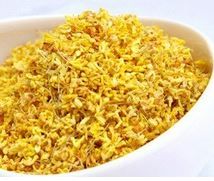
Osmanthus

Dried Osmanthus flowers, This golden yellowish flower has a pleasant floral aroma. Its unforgettable aromatic fragrance used in tea, food and worlds famous perfumes.

Drinking Gui Hua Wu Long Cha 桂花呜龙茶 is still redolent of my first smell of Gui Hua while visiting Hang Zhou, the capital city of Zhejiang Province, as tea leaves with flower petals combination I sampled the brew during our stay in Taiwan. Due to our stays and travel in south-east Asia and being ardent tea-drinkers, we have collected various tea leaves or have received tea box as gifts. Although standard tea bags are convenient, nothing compares to good quality tea leaves, you do not need to have a tea ceremony to enjoy a relaxing or soothing brew. More posts will follow with fragrant leaves from our home tea box, to share and enjoy its special characteristics. You might choose to put the kettle on now and read the Osmanthus Oolong tea blogpost.

guihua tangyuan

Guihua tangyuan 桂花汤圆
Photo courtesy source: http://eat.gansudaily.com.cn/

The beautiful Gui Hua image on top of this blog post is from an article featuring the health effects of Osmanthus in 养花百科(BaiKe Garden encyclopaedia). For Chinese readers click on the Chinese link as well this 白度 Baidu link for interesting Osmanthus facts and information.

Student brengt Chinese taalvariatie in beeld | Nieuws

Student brengt Chinese taalvariatie in beeld | Nieuws | Taalwetenschappen, Geesteswetenschappen | china, dialecten, sociale media, taalvariatie, twitter, chinees, cloud computing, corpus – Kennislink.

“Natuurlijk had ik wel gelezen dat ze in elk dorpje anders praten, maar tijdens die reis merkte ik het pas echt”, vertelt Van Esch. “In de Verenigde staten bestaat er een Twittercorpus waar dialectwoorden en hun plaats van herkomst in zijn opgenomen. Toen dacht ik: dat kan ik ook!” Dat is het Leiden Weibo Corpus [1] geworden. Weibo is de Chinese variant van Twitter waar ruim 300 miljoen Chinezen een account hebben. Eencorpus [2] is een grote verzameling taalmateriaal die zo gestructureerd is dat de gebruiker er makkelijk in kan zoeken.

Weibo is de Chinese variant van Twitter waar ruim 300 miljoen Chinezen een account hebben. Trowbridge Estate


Bron: Publicatie Universiteit Leiden – www.kennislink.nl


Entering China and internet

Arriving in Guangzhou bought at the airport an Unicorn mobile Sim Card for 130¥, basically overpaid according to our local friends, as at all Airports whether its for food or services. My husband bought one at the convenience store a day later for much less with immediate Internet access. While I had to figure out how to get settings right to get on-line four days later.

Acquiring internet access is not the problem in China, but what is still being cut off social media access by not having set up VPN access at home before I left. It is a headache if your travelling, what is available and working is Whatsapp, Foursquare and Path (latter has upload hick-ups).

Keeping in touch with our home-base in The Netherlands sharing theirs and our daily adventures and musings is more than just habitual. In between using Skype to have face-to-face chats is comfort for the soul.

However trying to upload my social media posts and reading my time-lines is a growing nuisance to me, so I’ve been looking for ways to get through and have been browsing for free VPN downloads.

Reading quite a few reviews I opted for Teamviewer 5, one of the articles I liked is written by Sarah Lynn for PCmag.com, The Best VPN Clients. While browsing for Teamviewer file I ran into a newly released update for Linux Teamviewer 7, which I’m trying to download and install.

No luck Linux doesn’t recognize the file, switching over to Ubuntu Software Center to get Shrew Soft VPN Access Manager to work instead. Have to get some help and support installing this program.

Hope this search doesn’t turn as cold as the weather, in Guangzhou we were enjoying daily average 25º Celsius, but now in Yiwu it has dropped to below 10º Celsius and going down to zero degrees within the next few days.