One of my favourite tea’s “Gui Hua Wu Long Cha” 桂花乌龙茶 or Osmanthus Oolong tea, has a subtle beautiful floral fragrance with a soothing taste. The very first time I smelled the Osmanthus perfume was during my first trip late 70’s visiting relatives in Hangzhou, China, just around the West Lake there was a scent in the air teasing my olfactory senses and I just didn’t know what it was or where to find the source. Since it was just a whiff I tried to describe to my family members the fragrance eager and curious to learn the answer, but I forgot that the scent although particular and unusual for me was actually something they unconsciously dismissed being familiar and not registering as I did at that moment. During our stay on one of many excursions and outings with extended family, they brought us to a famous park. While strolling around my nose caught the fragrance again and I couldn’t help myself by just following the wind direction trying to get close to the source. Luckily it didn’t take long because suddenly we were caught in a blast where the air was heavenly scented with flowery perfume and I could exactly pinpoint what I was trailing and smelling, they burst out laughing and said it was Osmanthus flowers from a small tree.

Photo courtesy Source: TCM Traditional Chinese Medicine Wiki https://tcmwiki.com/wiki/gui-hua.
Absolutely thrilled having discovered a little treasure, I asked in my ignorance whether it was all right to get a small flowering branch to bring along with me as a remembrance. The family also out-of-town villagers in their innocence conceded seeing my enthusiasm. While the group strolled on I walked to the tree and tried to snap a twig with my bare hands, but the task wasn’t as easy as I thought it would be. The little tree had sturdy branches and protected it from being mauled and vandalised by an intruder. Without tools to break off a twig I started like a monkey zealously to get hold by twisting in a circular motion on a branch with blossoming flowers. The delicate flowers were whirling around me and that got the attention of one of the park guards afar, who initially was wondering what was going on. Didn’t take long for him to come running and shouting all kinds of orders if only I had understood him.
As an overseas born Chinese teenager visiting ancestral home for the very first time, I only spoke my parent’s dialect at the time and had no comprehension of Hangzhounese nor Mandarin at all. While I was going happy-go-lucky, the park guard was red hot of fury upon seeing the act of destruction. To make matters worse, seeing that he was carrying one of those Chinese-type of round curved scissor I was just about to hand sign borrowing to prune the tree. At the same time, he was yelling and waving his hands rapidly too, lost in communication I held up my hand stating I had no idea what he wanted to convey to me. Trying to answer in my dialect he was flying off a whole string of words of which I only understood clearly one and new I was in trouble.
Chinese spoken language carries some universal words across dialects within their regions clearly identifiable, in this case, it’s the word egg “dan” 蛋, a nutritious and versatile protein source, it carries also a negative connotation in egg-related words “bendan” 笨蛋 stands for fool; idiot, “hundan” 混蛋 bastard, “shadan” 傻蛋 blockhead, simpleton, a humorous one is “lingdan” 零蛋 a duck’s egg meaning ‘zero’. He must have said at least one or maybe all of them and more, I sure had “egg on my face”.
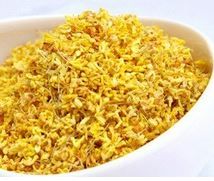
Dried Osmanthus flowers, This golden yellowish flower has a pleasant floral aroma. Its unforgettable aromatic fragrance used in tea, food and worlds famous perfumes.
Drinking Gui Hua Wu Long Cha 桂花呜龙茶 is still redolent of my first smell of Gui Hua while visiting Hang Zhou, the capital city of Zhejiang Province, as tea leaves with flower petals combination I sampled the brew during our stay in Taiwan. Due to our stays and travel in south-east Asia and being ardent tea-drinkers, we have collected various tea leaves or have received tea box as gifts. Although standard tea bags are convenient, nothing compares to good quality tea leaves, you do not need to have a tea ceremony to enjoy a relaxing or soothing brew. More posts will follow with fragrant leaves from our home tea box, to share and enjoy its special characteristics. You might choose to put the kettle on now and read the Osmanthus Oolong tea blogpost.

Guihua tangyuan 桂花汤圆
Photo courtesy source: http://eat.gansudaily.com.cn/
The beautiful Gui Hua image on top of this blog post is from an article featuring the health effects of Osmanthus in 养花百科(BaiKe Garden encyclopaedia). For Chinese readers click on the Chinese link as well this 白度 Baidu link for interesting Osmanthus facts and information.